

Blog
Medtech news, market engineering best practices, and updates.
Find our playbooks, ai models, articles about the medtech, and guest blogs here, updated weekly.
Find our playbooks, ai models, articles about the medtech, and guest blogs here, updated weekly.


Biotech startup funding runs on different rules than medtech. Here is what founders crossing into biotech capital often get wrong about leverage and equity.

A medical device pricing strategy set after launch is already too late. Here is the sequence that signals market maturity before the first sale.

Medical device startup funding closes faster when category work happens at pre-seed. Here's the traction gap founders hit right after FDA clearance.

The ambulatory surgery center shift is rewriting medtech strategy. Here is what founders need to adjust before ASCs become the default site of care.

A category creation strategy is the sequence medtech founders run before hiring sales: category, messaging, narrative, then go-to-market, in that order

A medtech product launch strategy built only around FDA clearance arrives too late. Here is what founders need to define before the device ever ships.

Market engineering is the discipline of designing, defining, and leading a medtech market instead of waiting for one to form. Here's the four-part formula.

A healthcare marketing strategy hired too early wastes a year of runway. Here is what medtech founders need to define themselves before hiring anyone.

A b2b go-to-market strategy fails in medtech when it launches before the category exists. Here is the sequence that holds up over a multi-year deal cycle.

Go to market strategy templates assume a category that already exists. Here is why medtech founders fill them in and still get no market response.

Social media marketing in the healthcare industry builds physician authority and category narrative, but it cannot close a hospital procurement committee.

Most b2b demand generation strategies in medtech capture demand instead of creating it. Here is the difference, and what to build first.

Medical device companies M&A hinges on the commercial function, not the technology. See what acquirers diligence before they sign, from real medtech exits.

Medical device sales culture runs most medtech companies, but hiring more reps rarely fixes a stalled market, here's what market engineering changes.

A medical device marketing agency can only fix an execution problem. Here are 14 agencies sorted by the job they do, and how to tell which you need.

A go-to-market strategy fails in medtech when it executes against a market that was never engineered — here's what has to come first.

A B2B demand generation agency can't fix a medtech market that hasn't formed yet — category design has to come first.

Most healthcare branding companies ship logos when medtech teams need category definition, positioning, and the market engineering work behind a real

Why the healthcare public relations agency medtech founders really need is a category-and-narrative shop: T-Mini, One Medical, Omar Khateeb on medtech

Why marketing services for healthcare that compound are vertical, full funnel, and market engineering-driven: MarketCraft, Neil Patel, and medtech fou

Why the digital marketing agency healthcare founders need is a vertical-focused shop: Neil Patel, Omar Khateeb on attention, verticals, and demand eng

The medtech investor narrative that closes rounds is built on market engineering, not projections: Omar Khateeb on category, traction, and $17B in med

Why the marketing agency pharma founders should hire is a category-and-attention shop: Chamath and Omar Khateeb on directing attention and engineering

Four company-building lessons for medtech founders from Travis Kalanick's August 2026 Founders podcast interview: management capacity, fundraising process over valuation, efficiency vs. subsidy, and productive pain.
Go-to-market strategy consulting for medtech: how Chamath, Omar Khateeb, and medtech commercial leaders build market engineering, not slide decks.

Surgical robotics M&A in 2026: Medtronic, J&J, Abbott, and Boston Scientific are moving aggressively, and the moat playbook goes back to US Surgical a

SEO services for healthcare that compound: how Neil Patel, medtech founders, and content teams engineer authority, video ranking, and thorough content

Why most medtech founders hire the wrong go-to-market strategy consultant: real failure modes I've watched from Kevin Rocco's Biorez exit to Axonics.

Why the healthcare PR agency medtech founders really need is a category-and-narrative shop, not press release production, per Bruce Cleveland and Omar

How Bruce Cleveland and medtech founders build category-defining content marketing in healthcare that compounds founder-led authority into deals.

What medtech Series A investors really underwrite: repeatable demand, engineered markets, and the specific pre-clearance evidence that closes rounds.

How to prepare for LSI medtech conference: what separates the medtech teams that leave LSI East with real investor momentum from the ones that don't.

What I learned about medical device funding in 2026 from the operators who closed rounds: Ray Cohen, Dan Rose, Mark McKenna, and Dennis McWilliams.

Ray Cohen took Axonics public in 2018 and sold it for 3.7 billion dollars. His readiness test explains why 15 other device companies never earned back their raise.

The five components of a medtech investor narrative that converts clinical proof into commercial conviction, with a pre-LSI East playbook for pre-traction founders.

How Intuitive Surgical Built a $200B Market by Understanding the Technology Adoption Curve in Medtech

What Is Traction in Business and Why Axonics Needed 20 Quarters to Build a $3.7B Exit

Most medtech founders time their first sales hire around a milestone or a resume. The real test is whether the person fits your product, market, specialty, and stage, and whether they can build the process your next five reps will run on.

Why content marketing in healthcare is market engineering infrastructure for pre-traction medtech founders, not brand awareness spend, and how MarketCraft builds it.

Bruce Cleveland's traction gap framework applied to medtech: the structural problem between early clinical adoption and commercial scale, and the two prerequisites for crossing it.

The 2026 marketing strategy framework for medical device companies, built around market engineering, commercial infrastructure, and stage-appropriate investment sequencing.

How to read the medical device sales company landscape as a commercial maturity signal, and the channel strategy decision between direct, independent reps, and distributors.

The three stages of building a medical device sales representative organization, and why most founders skip the most important one.

A four-type taxonomy of healthcare marketing agencies, which type pre-traction medtech founders need, and the questions that reveal which type you're talking to.

Why B2B medtech digital marketing diverges completely from consumer health digital marketing, and the channel-to-buyer-stage mapping that pre-traction founders need.

The digital marketing channels that build medtech pipeline at each commercial stage, and why channel-first thinking burns budget before the market is engineered.

Six questions medtech founders should ask any medtech marketing agency before signing, and the market engineering test most agencies fail.

What medtech founders get wrong when hiring a healthcare SEO company, and why category-creation SEO outperforms demand-capture SEO at the pre-traction stage.

What a healthcare branding agency should deliver for medtech isn't a logo. It's the clinical champion network and category narrative that earns hospital trust.

The three life sciences marketing mistakes that cost pre-traction medtech founders their Series B, and why pharma playbooks fail in early-stage medical devices.

Should a pre-traction medtech founder hire a life sciences marketing agency? Why market engineering practice builds markets while agencies run campaigns.

The 3 questions pre-traction medtech founders should ask any medical device marketing agency before signing, and why most agencies fail the market engineering test.

What Axonics Knew About Medical Device Sales Reps Before Building 20 Consecutive Profitable Quarters

How pre-traction medtech founders should evaluate healthcare marketing agencies versus medtech specialists, and the 4 questions that reveal which one actually knows the buyer.

Omar explains RA Capital's Elephant Slide board meeting framework and how MedTech CEOs can use it to show the whole company picture before any department update.

Greg Lucier touched $40B of healthcare M&A across Life Technologies, NuVasive, and Corza Medical. Here's the medtech serial acquirer strategy founders should study.

Kevin Rocco built BioRez into a $250M ConMed acquisition by engineering surgeon demand pre-launch. Here's the sports-medicine playbook founders should study.

Ray Cohen and Tom West named the three ways medtech VC incentives sabotage the best exits at MD&M 2026. Here's the breakdown founders need.

The Prometheus Biosciences Merck acquisition compounded a $700M IPO into a $10.8B exit on precision medicine sequencing. Here's how CEO Mark McKenna built it.

A medtech reimbursement strategy that compounds starts two years before FDA clearance. Here's the sequence VAC operators tell founders to follow.

Most medical device commercialization plans miss six structural gaps that kill cleared products before year two. Here's the diagnostic founders need.

Category design captures 76% of profits in any new market. Here's what Bruce Cleveland teaches medtech founders about doing the work pre-launch.

Most healthcare SEO agencies chase volume when medtech buyers run on authority. Here's what Neil Patel teaches medtech founders about agency selection.

Medical device market access decisions set the real launch date. Here's why payers, IDNs, and VACs need engineering work two years before FDA clearance.

How Intuitive Surgical's Commercial Strategy Built a $200B Pull-Driven Market Around da Vinci

A medical device go-to-market strategy that compounds across stages runs on distribution efficiency, not on rep headcount. Here's the sequence.

A disciplined medical device marketing strategy runs four sequenced disciplines before sales hire. Here's the framework Bruce Cleveland taught medtech founders.

Healthcare content marketing works as a demand-engineering engine, not a lead-capture funnel. Here's the 12-18 month sequence Bruce Cleveland teaches medtech founders.

May 2026 medtech M&A and Q1 earnings follow the same pattern. Omar Khateeb breaks down what it means for pre-traction founders.

Most medtech founders hire a marketing agency before they've defined their category — and burn a year of runway proving it.
LimFlow built a procedure category around patients everyone else had given up on. Inari Medical paid $250M to own it.
Most medtech founders skip straight to hiring sales. Bruce Cleveland's market engineering framework explains why that's the wrong sequence, and what to build first.
Greg Lucier took Life Technologies from $2B to a $13.6B exit. Here's the operating philosophy he's used to build medtech companies acquirers need to buy.
FDA clearance opens the door. Four in five medtech companies walk through it and find no one waiting.
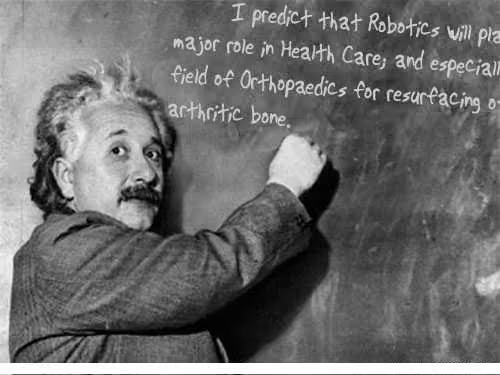
Maurice Ferré built MAKO Surgical from the most-shorted medtech stock into a $1.65B Stryker acquisition. The founding CEO tells the full story on The State of MedTech.
Six exits. $17 billion combined. The founders who built them share seven lessons most medtech founders learn too late.
Most medtech founders hire a sales team right after FDA clearance. Bruce Cleveland spent 20 years in venture watching that fail.
Ray Cohen ran 20 consecutive quarters beating analyst expectations before Boston Scientific acquired Axonics for $3.7B.
Hosting the State of Medtech podcast I noticed a common theme as I interviewed founders, VCs, and strategics.