LimFlow-Inari Medical: The $250M Acquisition Nobody Saw

Key Takeaways
- Category ownership commands acquisition premium. LimFlow's TADV (transcatheter arterialization of deep veins) didn't exist as a defined procedure until they legitimized it. That ownership translated to a significant multiple.
- NEJM publication is a category-defining moment. The PROMISE II trial, published in NEJM, moved LimFlow from "one company with a device" to "the recognized standard for a patient population." Acquirers pay for recognized categories.
- "No Option" patients unlock strategic value. LimFlow focused on the 5-10% of CLTI patients where all other interventions had failed. This specificity became their competitive moat.
- Acquirers solve problems, not buy technology. Inari Medical acquired LimFlow to own the No Option CLTI space. The device was the vehicle. The category was the acquisition.
- Founders should build toward category inevitability, not just product excellence. The path to acquisition premium is to become so identified with a patient problem that your exit feels like the market correcting itself.
In March 2024, Inari Medical acquired LimFlow for $250 million. The headline was the price. The story was different.
LimFlow didn't have the biggest market, the longest clinical track record, or the most revenue.
What they had was something harder to copy: they owned a category that didn't exist five years before.
They took the patients nobody else would treat, people with chronic limb-threatening ischemia so severe that conventional surgery was impossible, and they proved, in the New England Journal of Medicine, that amputation wasn't inevitable.
That $250 million was for the category they built around the technology.
Watch the full episode on YouTube
As I said on the episode: "What I love about LimFlow is that it's such a great example of medtech doing something truly different.
They bypass a problem…. That's physiological engineering."
This post gives you the story behind the acquisition: how LimFlow built a new procedure category, why the PROMISE II data mattered to the acquirer, and what founders building toward an exit can learn from the way Dan Rose and Dr. Kinam Hong approached the market.

The Patients Nobody Else Would Treat
In interventional cardiology and vascular surgery, there's a category of patients that makes clinicians pause.
They have chronic limb-threatening ischemia (CLTI) so severe that their limbs are at immediate risk of amputation.
They've been through revascularization. They've had endovascular interventions. They've had bypass surgery. Nothing worked.
Clinically, these are called "No Option" patients. In real terms, they're people facing amputation because conventional medicine has run out of tools.
"What we're trying to do is save the leg. When you save the leg, you save the lives. Patients with amputation their five-year survival is less than 30%. It's like cancer, or worse than many other cancers."
— Dr. Kinam Hong, Partner, Sofinnova Partners (The State of MedTech, ep. 164)
Before LimFlow, the standard answer was amputation. Not because doctors wanted to amputate. Because they had no alternative.
This population matters for one critical reason: it's a defined, measurable, emotionally charged segment.
An 82-year-old farmer who gets to keep his leg is not a statistical data point to him. He's alive differently. His family's story is different.
That specificity, that human weight, is what creates category ownership.
LimFlow didn't invent TADV to solve a theoretical problem. They invented it because these patients existed, they were being amputated, and nobody in the device industry was building for them.
Building the TADV Category
Transcatheter arterialization of deep veins sounds technical. The concept is elegant.
In No Option CLTI, the arterial system is destroyed. Revascularization has failed. But the deep veins are intact.
LimFlow's insight: use those deep veins as a new arterial system. Create a connection between the artery and the vein. Reroute blood flow. Salvage the limb.
"We were treating and that is still our indication of what's called No Option patients: patients who could not get any further endovascular surgical treatment, essentially consigned to amputation. These are the sickest, hardest, most fragile CLTI patients that exist. The concept was: if we can help those patients, the worst of the worst, the sickest of the sick, we're going to be able to show real impact."
— Dan Rose, CEO, LimFlow (The State of MedTech, ep. 164)
It's a category that didn't exist before LimFlow defined it. And LimFlow built that category on the hardest possible clinical standard.
"LimFlow always used hard endpoints, not surrogate endpoints. I tell people: we don't do patency studies. We're doing amputation and death studies. Because that's what the patient cares about pain, amputation, and not losing their life."
— Dan Rose, CEO, LimFlow (The State of MedTech, ep. 164)
This matters strategically. When you define a new procedure and validate it on the outcomes that matter most to patients and acquirers alike, you become the reference point.
Every conversation in interventional cardiology, every training program, every hospital credentialing decision starts with "Well, LimFlow does TADV, and..." That positioning is worth millions in acquisition negotiations.
Strategic acquirers don't buy me-too devices. They buy categories.
They buy the ability to say "We now own the No Option CLTI space because we own the company that defined how to treat it."
Inari Medical made that move. After the acquisition, they didn't need to invent a new approach. They inherited one. They inherited the category.
The PROMISE II Study and NEJM Publication
Clinical evidence exists on a hierarchy. A retrospective case series is one thing. A prospective randomized trial published in the New England Journal of Medicine is another.
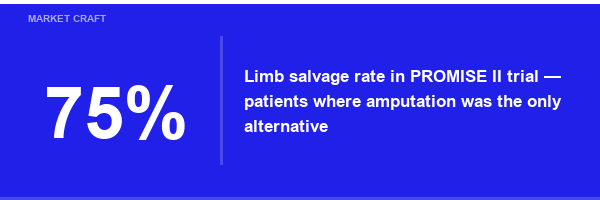
LimFlow ran PROMISE II, a prospective trial of TADV in No Option CLTI patients with 105 enrollees. The results were the category-defining moment.
"Seeing 75% limb salvage at six months in patients who were going to get amputated and you see these wounds healing, and you see the feet staying warm, and the patients getting active again. It's obvious to everybody that there's something there."
— Dan Rose, CEO, LimFlow (The State of MedTech, ep. 164)
That number went into the New England Journal of Medicine.
And that's when LimFlow stopped being "that company trying a new procedure" and became "the recognized standard for treating No Option CLTI."
This is a founder insight worth understanding. Publishing in NEJM is about category legitimacy, not ego.
It moves a company from "we have a product" to "we have a recognized, peer-validated approach to a clinical problem."
When Inari Medical made the acquisition offer, they weren't negotiating for a device. They were negotiating for the clinical legitimacy that NEJM publication provided. They were acquiring the category.
Why Inari Medical Was the Right Acquirer
Inari Medical is a major player in peripheral vascular intervention.
They have the sales force, the hospital relationships, the reimbursement infrastructure, and the clinical credibility to deploy TADV at scale. They have the channels.
LimFlow had the category. Inari Medical had the distribution. And critically, they shared a philosophy about how to build a market.
"They have a tremendous amount of experience developing markets. They are a real market development company from a mindset point of view. The more we talked to them, the more we felt like we had so much culture in common. This is a market development opportunity. We're creating a market."
— Dan Rose, CEO, LimFlow (The State of MedTech, ep. 164)
From an acquirer's perspective, this is the highest-probability acquisition: buying a defined clinical category with NEJM validation and pairing it with proven distribution.
The fit is operational, not speculative.
From a founder's perspective, this is the playbook.
Build something so specific, so validated, so necessary that when a company with distribution capability shows up, the acquisition becomes the natural conclusion.
Inari Medical didn't acquire LimFlow as a financial play. They acquired them as a strategic necessity.
They wanted to own the No Option CLTI space. LimFlow was the only way to do that.
That difference shows up in the price.
What Founders Should Take from the LimFlow Story
There's a principle here that applies across medtech. Most founders focus on being the best in their category. LimFlow focused on owning the category itself.
They did three things consistently.
First, they chose a patient population nobody else wanted. No Option CLTI was a niche. It was small.
But it was real, it was specific, and it was desperate for a solution. Other companies might have chased larger markets. LimFlow went where the need was most acute.
Second, they published. Not to win awards. To establish clinical legitimacy. The NEJM publication moved them from "interesting approach" to "recognized standard." That distinction is the category moat.
Third, they positioned relentlessly around category ownership.
Every conversation with Inari Medical, every hospital conversation, every clinician conversation was built on the idea that LimFlow didn't just have a device.
They owned the space where that device lived.
When acquisition time came, Inari Medical didn't negotiate price on the device. They negotiated prices for the category.
The lesson: founders should engineer the market itself. Choose your patient population with precision, validate with the clinical evidence that matters most, and position yourself as the category owner.
For the full framework on building toward an exit, read the medtech exit playbook.
Frequently Asked Questions
What is TADV and how does it differ from traditional revascularization?
TADV (transcatheter arterialization of deep veins) is a fundamentally different approach to CLTI. Traditional revascularization tries to restore blood flow through the arterial system.
TADV acknowledges that when arteries are destroyed, the veins are still intact, and converts a deep vein into an artery to create a new pathway for blood flow.
That pivot, from repairing the arterial system to routing around it entirely, is what makes TADV a procedure category and not just a product variant.
Why did PROMISE II data matter so much to the acquisition?
The PROMISE II trial moved LimFlow from "one company with a hypothesis" to "the peer-validated standard for a defined patient population."
NEJM publication means hospital credentialing committees recognize TADV as legitimate. It means interventional cardiologists have peer-reviewed evidence. It means payers have a reference standard.
For an acquirer, peer-validated data is worth far more than company-sponsored research. That's what separates a category from a product.
What made LimFlow an attractive acquisition for Inari Medical specifically?
Inari Medical has the distribution infrastructure, hospital relationships, and payer relationships to scale interventional vascular therapies. LimFlow had a defined patient population and peer-validated evidence but limited distribution.
Inari Medical could take a validated procedure with proven clinical outcomes and deploy it across their entire network. A defined market, proven outcomes, ready distribution.
How should founders think about acquisition strategy during clinical development?
Category ownership should be intentional from clinical planning forward. Choose a specific patient population early. Design trials that will create peer-validated evidence in journals that matter to your acquirer.
Position relentlessly around category definition. You're not just proving your device works. You're proving that your patient population is a category that needs a standard solution.
The device is the vehicle. The category is the asset.
Listen to Dan Rose and Dr. Kinam Hong's Full Story
Watch the full episode on YouTube
Dan Rose and Dr. Kinam Hong's full conversation on building LimFlow, from the No Option CLTI patient population through the PROMISE II trial and the Inari Medical acquisition, is on The State of MedTech.
Subscribe wherever you listen to podcasts.
About Dan Rose
Dan Rose was the CEO of LimFlow from the company's founding through its $250 million acquisition by Inari Medical in 2024.
He previously held executive roles in the peripheral vascular and endovascular device industry and led the clinical development and commercialization of the transcatheter arterialization of deep veins (TADV) procedure.
About Dr. Kinam Hong
Dr. Kinam Hong is a Partner at Sofinnova Partners, a leading European life sciences venture capital firm.
A physician by training, he brings a clinical and scientific perspective to medtech investing.
LimFlow was Sofinnova's first investment in the TADV space and, following the $250 million Inari Medical acquisition, also their first exit.
About the Author
Omar Khateeb is the founder of MarketCraft and host of The State of MedTech, the number one podcast in the medtech industry.
He works with medtech founders and commercial leaders on market engineering, commercialisation strategy, and revenue growth.
Visit marketcraft.ai or subscribe to The State of MedTech for weekly conversations with the people building the future of medical devices.