Medtech Commercialization Strategy: Why 4 in 5 Fail Post-FDA
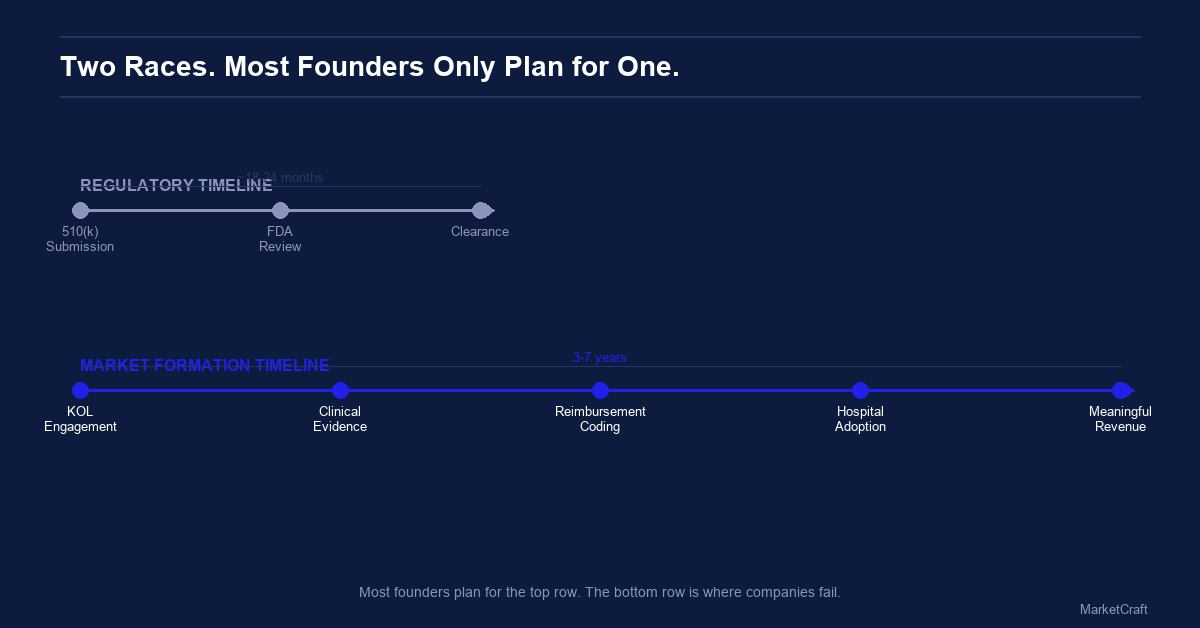
FDA clearance is the starting line of a completely different race. Most founders mistake it for the finish line.
The device cleared. The regulatory nightmare is over. You can now legally sell it. And then what?
The companies that fail after clearance aren't failing because their technology doesn't work. They're failing because the market they expected to pull their device into doesn't exist, or it exists, but the friction to adoption is higher than their capital, patience, or operational stamina can overcome.
Ramin Mousavi learned this firsthand at CathWorks. Gary Guthart watched it happen to Intuitive Surgical before they found the right beachhead. Craig Gaffin, who runs global orthopedics at Smith+Nephew, sees it repeat across the industry every cycle. Each of them sat down with me on The State of MedTech to break down what happens after FDA clearance, and why so many companies don't survive it.
Watch the Ramin Mousavi episode on YouTube
Watch the Gary Guthart episode on YouTube
Watch the Bruce Cleveland episode on YouTube
This post pulls from all three conversations. By the end, you'll understand where the second wall is, why most companies hit it, and how the ones that survive plan around it.
Key Takeaways
- FDA clearance proves the device works. It doesn't prove the market will pay for it or change their workflow to use it.
- The two-phase problem: regulatory clearance and commercial clearance are separate hurdles, both expensive. Most founders plan only the first.
- Wrong beachhead kills adoption before it starts. The most obvious first customer is almost never the right one.
- Medtech adoption timelines run 3-7 years from clearance to meaningful revenue. Most founders budget for 6-12 months.
- Market pull where hospitals call you instead of the other way around, is the end state. Getting there requires engineering the market, not just executing sales tactics.
Bruce Cleveland, VC and creator of the market engineering framework at Traction Gap Partners, calls it the two-phase problem. Phase one is regulatory clearance. Phase two is commercial clearance.
Regulatory clearance proves the device is safe and effective in a clinical trial. Commercial clearance proves the market will adopt it at scale. That second phase requires:
- Hospital procurement approval (committee meetings, value analysis board questions, contracting)
- Reimbursement coding from payers (new CPT codes, coverage decisions, prior authorization rules)
- Surgeon training and credentialing (new technique credentialing, procedure time reduction, complication learning curve)
- Clinical evidence generation beyond the FDA submission (real-world outcomes, publications, case series)
- Market awareness among the people who decide to buy (KOLs, hospital administrators, purchasing directors, payers)

Most medtech founders have an 18-24 month regulatory roadmap and no roadmap for phase two at all.
"FDA clearance doesn't clear you through the market. That's the next big hurdle, and it's why a lot of firms don't invest in medtech. They know it's a two-phase problem. You have to clear the commercial part, and it's very expensive to do that. Few do the work — which is rather shocking."
— Bruce Cleveland, Founder, Traction Gap Partners (The State of MedTech, ep.278)
This is why venture capital has pulled back from medtech. They know both phases are expensive. The companies that survive are the ones that raised capital for both phases, or found a strategic partner who can absorb the commercial phase on their balance sheet.
CathWorks built an AI system that analyzes coronary physiology, it takes FFR (fractional flow reserve) measurements and tells a cardiologist whether an artery is truly blocked or just looks blocked on imaging.
They cleared FDA. They launched commercially. The market didn't form.
The problem: the analysis took over 20 minutes to run. Twenty minutes in the middle of a procedure is a lifetime. Cardiologists understood the technology was useful and didn't adopt it anyway. The friction was too high. The clinical benefit didn't justify the workflow disruption.
Then CathWorks upgraded the algorithm. Analysis time dropped from over 20 minutes to under two minutes.
That's when the market pulled.
"We took it from taking over 20 minutes to do an analysis to now less than two minutes. That's the point where they believed that this could be commercial."
— Ramin Mousavi, CEO, CathWorks (The State of MedTech)
The technology was proven two years earlier. Market validation didn't come from FDA clearance. It came from solving a workflow friction that made the tool usable.
FDA clearance ends the credibility problem. It doesn't create demand. Demand forms when three conditions align: clinical evidence that it works, workflow integration that doesn't require the surgeon to change their fundamental technique, and reimbursement that makes financial sense.
CathWorks is now in a Medtronic build-to-buy arrangement with over $70 million in upfront funding and an acquisition option at roughly $575 million. Medtronic moved in because the market had started pulling. The friction dropped. The adoption curve was turning. That sequence is the part founders skip when they ask how to exit a medtech company.
Intuitive Surgical created the surgical robotics category. The da Vinci system is now used in hundreds of thousands of surgical procedures per year.
Here's what almost nobody knows: they didn't start with urology or gynecology. They started with cardiac surgery.
Cardiac surgeons rejected the system. The on-console surgeon couldn't get the sensory feedback they needed for a beating heart. The clinical case didn't land. And the surgeons with the most political power in the hospital said no.
So Intuitive pivoted to urology. Urologists wanted the technology. Faster, less invasive, less blood loss, shorter hospital stays. The clinical benefit was undeniable, and the urologist community was hungry for an alternative to open surgery.
That's where Intuitive found pull. That's where the market formed.
Gary Guthart, Intuitive's CEO, described the lesson this way: when you're selecting your first customer segment, you're not looking for the biggest total addressable market. You're looking for the fastest adoption, the clearest clinical case, and the most motivated clinical champion.
For surgical robotics, it wasn't the cardiac surgeons with the most institutional power. It was the urologists with the most acute clinical need.
The most obvious first customer for your technology is almost never the right one.
The beachhead isn't a tactical choice. It's the decision that determines whether clinical evidence accumulates in your favor or stalls, whether KOLs advocate for you or stay neutral, whether procurement gets easier or stays a fight.
Pick a segment where the clinical case is marginal and you'll spend years defending the technology instead of scaling it. Pick the segment with the most acute need and a motivated champion, and adoption becomes self-reinforcing.
Most medtech founders model timelines based on regulatory expectations: get FDA clearance in 18-24 months, hit the market in month 26, start meaningful revenue at month 30.
Surgical device adoption takes 3-7 years from clearance to meaningful revenue. Not 30 months. Three to seven years.
Why? Because every step in the commercial phase takes longer than founders budget for:
- First hospital customer: finding the right champion, getting through the value analysis board, negotiating contracts, completing training. 6-12 months.
- Building the KOL network: identifying the surgeons who believe in the technology, getting them to publish, getting them to present at conferences, getting their peers to listen. 12-24 months.
- Establishing reimbursement: working with payers to get CPT codes assigned, proving health economic value, establishing coverage policies. 12-18 months if you move fast.
- Training at scale: credentialing surgeons at every hospital, supporting the learning curve, managing early complications, iterating on the procedure. 18-36 months.
Capital runs out around month 24-30 because founders budgeted for regulatory and early launch, not for the adoption timeline.
The companies that survive raised for the commercial phase explicitly. Or they found a strategic partner who brought their own distribution network.
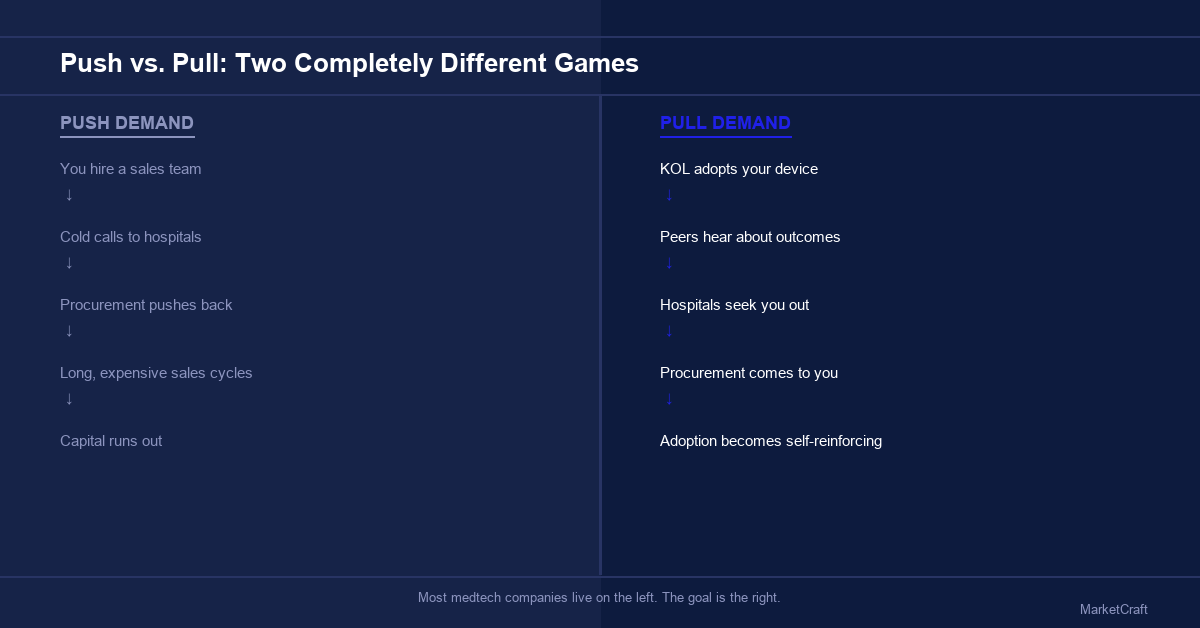
The goal of commercialization strategy is to engineer pull rather than push.
Push is what most medtech companies default to. You hire sales reps and call it a medical device go-to-market strategy. They call hospitals. They pitch the device. They fight procurement. It's expensive, slow, and exhausting.
Pull is when hospitals call you. When surgeons request your device by name. When procurement comes to you instead of you chasing procurement.
Intuitive eventually created pull in urology. Surgeons wanted the da Vinci system so badly that hospitals felt pressure to install it to attract those surgeons. The demand wasn't manufactured by sales reps. It was generated by clinical adoption and peer validation.
This took years. But once pull formed, the scaling math changed completely.
Craig Gaffin, who leads global orthopedics at Smith+Nephew, cited Intuitive as the proof of concept for how to engineer market pull. The device wasn't the magic. The execution was the relentless focus on clinical validation, on training at scale, on building a community of surgeons who advocated for the system not because they were paid to, but because they saw the clinical benefit firsthand.
If you're working through your post-clearance commercialization strategy, see how MarketCraft works with medtech founders.
If you've cleared FDA and you're looking at what comes next, here's how the commercial phase works:
Not adoption barriers in general. The specific barriers for your device in the segment you're targeting. Is it workflow time? Clinical evidence? Hospital purchasing complexity? Payer coverage? Reimbursement value? Training burden? Complication risk?
Each barrier requires a different strategy. If your barrier is workflow time, you need product iteration (like CathWorks). If your barrier is clinical evidence, you need a publication strategy. If your barrier is reimbursement, you need health economic modeling.
Your beachhead is the first market segment where all three conditions are true: fastest adoption, clearest clinical case, most motivated champion.
Not the biggest market. Not the most prestigious segment. The one where you can generate pull fastest. The full medtech go-to-market strategy framework covers how to sequence this correctly.
Regulatory capital doesn't cover commercialization. Get a separate funding round explicitly for phase two, or negotiate a strategic partnership that brings distribution.
Most companies that fail do so because capital ran out around month 24. They'd solved the regulatory problem. The commercial problem, the market formation problem, was just getting expensive.
First customer in year one. KOL network in years 1-2. Reimbursement established in years 1-2. Scale training in years 2-3. Meaningful revenue by year 3-4.
Everything takes longer than you expect because hospitals, payers, and surgeons all move slowly.
What is medtech commercialization strategy?
Commercialization strategy is the plan for getting surgeons, hospitals, and payers to adopt your device after FDA clearance. It covers KOL selection, hospital targeting, reimbursement management, clinical evidence generation, and scaling surgeon training. Most medtech companies confuse commercialization with sales. Commercialization is engineering market demand. Sales fulfills it once the demand exists.
FDA clearance proves the device is safe and effective in a clinical trial. It doesn't prove the market will adopt it. Companies fail when adoption barriers are higher than their capital, when they pick the wrong beachhead, when their timeline expectations are unrealistic, or when they don't plan for the commercial phase at all. The most common failure is a timing mismatch: founders budget 6-12 months to revenue but adoption takes 3-7 years.
Surgical devices typically take 3-7 years from FDA clearance to meaningful revenue. That includes establishing first hospital customers (6-12 months), building the KOL network and clinical evidence (12-24 months), getting reimbursement established (12-18 months), and scaling training and adoption across hospitals (18-36 months). Companies often underestimate this and run out of capital around year two.
Pull-driven demand is when surgeons request your device by name, when hospitals want to install it to attract certain surgeons, when payers proactively reach out about coverage. It's the end state of successful commercialization. Pull forms when clinical evidence is strong, when respected surgeons advocate for your technology, and when the workflow benefit makes adoption feel inevitable.
pharmaceutical commercialization?
Pull-driven demand is when surgeons request your device by name, when hospitals want to install it to attract certain surgeons, when payers proactively reach out about coverage. It's the end state of successful commercialization. Pull forms when clinical evidence is strong, when respected surgeons advocate for your technology, and when the workflow benefit makes adoption feel inevitable.
pharmaceutical commercialization?
Pharma sells through formularies, pharmacy benefit managers, and prescribing physicians. Medtech sells through Value Analysis Committees, IDN procurement, and GPO contracts instead. There, the surgeon, the hospital administrator, and the payer each hold a veto over the same purchase. That's why surgeon training time, procedure time, and real-world outcomes data all become part of the commercial argument. None of that factors into pharma.
For surgical devices, the commercial phase usually costs more than the regulatory phase did. That budget has to cover clinical evidence generation, KOL development, reimbursement work, and surgeon training. It also has to fund sales infrastructure, spread across 3-5 years. But most founders assume early revenue will fund it. It rarely does at that scale. That's why a separate commercial raise or a distribution partnership closes the gap.
It runs in four stages:
- Map the specific adoption barriers for your device in the segment you're targeting.
- Pick one beachhead where the clinical need is acute enough to force a workflow change.
- Raise for the commercial phase as its own line item.
- Plan for 3-7 years of evidence, training, and reimbursement work before revenue compounds.
The three State of MedTech episodes behind this post:
- Map the specific adoption barriers for your device in the segment you're targeting.
- Pick one beachhead where the clinical need is acute enough to force a workflow change.
- Raise for the commercial phase as its own line item.
- Plan for 3-7 years of evidence, training, and reimbursement work before revenue compounds.
The three State of MedTech episodes behind this post:
Subscribe wherever you listen to podcasts.
Omar Khateeb is the founder of MarketCraft and host of The State of MedTech, the number one podcast in the medtech industry.
He works with medtech founders and commercial leaders on market engineering, commercialization strategy, and revenue growth. Visit marketcraft.ai or subscribe to The State of MedTech for weekly conversations with the people building the future of medical devices.