How to Exit a Medtech Company: 7 Lessons Learned Too Late
How to Exit a Medtech Company: 7 Things Founders Learn Too Late
Nobody finds you in medtech exits. You engineer being found. And the founders who've done it best spent years building that outcome before they ever sat across a deal table.
The market celebrates the exit number. Nobody talks about the 18 months of deliberate work that produced it.
I've hosted over 360 episodes of The State of MedTech. In that time, I've spoken with founders who've built and exited companies worth hundreds of millions, some worth multiple billions. When I go back through those conversations, the same patterns show up again and again.
These are 7 lessons from six founders who navigated it from exits totaling over $17 billion combined. Ray Cohen at Axonics ($3.7B to Boston Scientific). Mark McKenna at Prometheus Biosciences ($10.8B to Merck, the largest biotech deal of 2023). Dan Rose at LimFlow ($250M+ to Inari Medical). Kevin Rocco at Biorez ($250M to CONMED). Greg Lucier, who built and exited NuVasive and Life Technologies. And Dr. Gregory Hanson, who built a physician-founded startup through acquisition.
Watch the conversations that informed this article on The State of MedTech.
Key Takeaways
- Most medtech exits require 3-7 years of deliberate acquirer relationship-building before deal talks begin
- Founders who appear not to need a sale consistently negotiate from stronger positions. Over 85% of biotech deals involve only one buyer
- Clinical trial design (which investigators you recruit, which endpoints you measure) shapes your negotiating position as much as your regulatory outcome
- Acquirer culture fit and commercial focus predict post-acquisition patient outcomes more accurately than deal size
- CEO temperament under adversity is a stronger predictor of exit success than the quality of the underlying technology
Lesson 1: Acquirer Relationships Take Years, Not Weeks
Every founder who got a premium exit said the same thing in different words: the conversations that mattered most weren't the deal conversations. They were the ones two, three, four years earlier.
Dan Rose built LimFlow into a $250M+ acquisition by Inari Medical. When I asked him how that deal came together, he was clear about what got them there.
"It takes years. I think it's very rare for someone in medtech to wake up and say, 'That was a great pitch — let's buy them.' In my experience, you spend years cultivating relationships with strategics. You really have to work hard to touch many points."
— Dan Rose, CEO, LimFlow (The State of MedTech, ep. 164)
Ray Cohen's story at Axonics runs the same pattern. Boston Scientific didn't discover Axonics in 2022. Their familiarity with the company had built over years (through conference conversations, commercial tracking, clinical presence) before any deal discussion started.
By the time Boston Scientific moved, their internal familiarity with Axonics was already distributed across CFO, R&D, commercial, and legal. That's why the deal could close fast.
The practical implication: if you're two years from where you want to exit and you haven't started actively mapping potential acquirers and their internal decision-makers, you're already behind. Not fatally so. But behind.
Map the five to seven strategics where your technology would make sense. Find out who the actual decision-makers are. Get into the rooms where those people show up. And start now. Not when the data comes in.
Lesson 2: Showing You Don't Need to Sell Is Your Best Negotiating Move
This is counterintuitive to almost every founder I've spoken with. And it's one of the most consistent patterns across the exits that went well.
Mark McKenna took Prometheus Biosciences to a $10.8 billion exit to Merck. His framing of the exit process is one of the clearest I've heard on the show.
"The best way to generate value for your shareholders is to create a competitive process. That means more than one or two bidders. You need to signal the fact that you're not for sale — but you're open to a dialogue."
— Mark McKenna, CEO, Prometheus Biosciences (The State of MedTech, ep. 210)
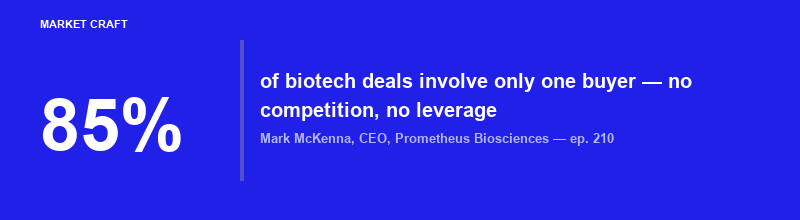
He also flagged a stat worth sitting with: over 85% of biotech deals involve only one buyer. One buyer means no competitive tension. And when there's no competitive tension, you're not negotiating. You're accepting.
Dan Rose had a harder version of this lesson. He was initially hesitant to bring a strategic investor into LimFlow's Series D, and his reasoning revealed the hidden cost of strategic capital.
"If a strategic invests and they don't buy you, other strategics see that and wonder why they're not buying. You can lose leverage with other potential acquirers."
— Dan Rose, CEO, LimFlow (The State of MedTech, ep. 164)
Strategic investors on your cap table are not always the asset founders assume they are. If the strategic relationship becomes complicated, it can narrow your buyer field. And that contraction happens without anyone intending it.
The founders who generated the highest exit values all had something in common: a credible alternative to selling. Prometheus could have run Phase 3 independently. Axonics was generating over $200M in annual revenue before Boston Scientific came in. LimFlow had a clear path to IPO.
As you build strategic relationships over time, the posture is always: we're building something important, we're open to the right conversations, and we'll be fine either way.
Lesson 3: Hard Endpoints Beat Surrogate Measures. Every Time.
Most medtech startups design their clinical trials to satisfy the FDA. The best ones design them with the full commercial and acquisition outcome in mind.
LimFlow's clinical program is the clearest example I've covered. The condition they were treating (chronic limb-threatening ischemia, the kind that ends in amputation) had been studied mostly using surrogate endpoints like blood flow patency rates. Dan made a different call.
"LimFlow always used hard endpoints, not surrogate endpoints. We don't do patency studies. We do amputation and death studies. Because that's what the patient cares about."
— Dan Rose, CEO, LimFlow (The State of MedTech, ep. 164)
The data they generated (75% limb salvage at six months in patients who were otherwise heading toward amputation) was something Inari's team could read without extrapolation. No surrogate mapping, no projections. Patients either kept their limbs or they didn't.
Acquirers don't want to buy clinical risk they can't quantify. Hard endpoint data eliminates that uncertainty. It also simplifies the payer reimbursement conversation post-acquisition, which Inari knew they'd face immediately.
Both of those things increase company value before a deal conversation ever starts. If your current trial is built around surrogate measures, ask whether you're optimizing for clearance alone, or for the full outcome you want.

Lesson 4: Your Trial Investigators Are a Strategic Asset
Most founders recruit the world's leading believers in their approach, the physicians most aligned, most experienced, most likely to become champions. Dan Rose deliberately went the other direction.
"I wanted people who were unconvinced. I wanted leaders in the vascular surgery community — surgeons who are often more conservative in adopting new techniques than interventionalists. When that type of person gets on the podium and is willing to publish and back you up, that's gold. If it's just a bunch of believers, the other group is going to say, 'We don't trust that.'"
— Dan Rose, CEO, LimFlow (The State of MedTech, ep. 164)
He gambled on it and won. When conservative vascular surgeons became the ones endorsing LimFlow's outcomes, the rest of the surgical community paid attention in a way they wouldn't have for a dataset from enthusiasts. The same mechanism applied at Inari's acquisition table.
Your investigator list carries commercial and strategic consequences that outlast any single trial. Market adoption and deal valuation both trace back to who you chose to put on the podium. Choose the skeptics. Let them become the proof.
Lesson 5: Acquirer Culture Fit Predicts Post-Acquisition Outcomes Better Than Deal Size
Across more than 250 conversations on this show, the exits that went best for patients, employees, and founders were often not the ones that went to the largest acquirer.
Inari Medical acquired LimFlow with a market cap of roughly $3-4 billion at the time of the deal. Not a giant by medtech standards. But their entire commercial focus was on vascularization for at-risk patients. LimFlow wasn't going to be one of 50 products in a rep's bag.
"Inari had so much culture in common with us. They had invested in market development for years in a space where not everyone believed it would become what it is today."
— Dan Rose, CEO, LimFlow (The State of MedTech, ep. 164)
Ray Cohen made the same calculation at Axonics. Before agreeing to terms with Boston Scientific, he studied their CEO Mike Mahoney's leadership style and the company's internal culture.
"Mike Mahoney is one of the greatest guys you'll ever meet. He's authentic as the day is long. The culture of the company, the way they go about doing business — it fit. It matched with Axonics and they're really good people."
— Ray Cohen, CEO, Axonics (The State of MedTech, ep. 245)
Cohen also made sure most Axonics employees continued at Boston Scientific after close. That wasn't a coincidence. He specifically evaluated potential buyers on that criterion before accepting terms.
The reason this matters more than founders often acknowledge: patient outcomes depend on commercial execution after the deal closes. If the acquirer's reps aren't incentivized to prioritize your product, if it's a minor portfolio addition rather than a strategic priority, adoption stalls.
A smaller acquirer where your technology sits at the center of their strategy will often drive better outcomes (for patients and for earnout structures) than a giant where it becomes line 37 of 80. Choose the acquirer who will take the technology seriously after the papers are signed.
Lesson 6: Phase 2 Data Is the Highest-Leverage Exit Window
This applies most directly to biotech and pharma-adjacent companies. But the underlying principle extends broadly: the strongest exit timing is when clinical risk has just been materially de-risked, and the growth story is still fully priced in.
Mark McKenna educated 17 potential acquirers on Prometheus Biosciences throughout the company's development (all under CDA) before Phase 2 results came in. Not 17 pitches. 17 ongoing education conversations. He built context and relationships. Then he waited.
"The data came out — we set a new high-water mark for remission rates in inflammatory bowel disease. We quickly pivoted to our playbook: operate as an independent company unless someone comes in with a serious offer."
— Mark McKenna, CEO, Prometheus Biosciences (The State of MedTech, ep. 210)
Someone did. $10.8 billion.
Before Phase 2 data, acquirers are buying a hypothesis. The risk is high and they price it accordingly. After Phase 3, the risk is lower, but so is the upside. Right after strong Phase 2 data is where founders have both the proof and the remaining upside working simultaneously in their favor.
Founders who hold through Phase 2 with genuine conviction in their readout, and move fast when the data supports it, consistently capture significantly more value than those who exit early to take risk off the table.
Lesson 7: CEO Temperament Under Adversity Predicts Exit Outcomes More Than Technology Quality
Every exit I've studied had a point where it almost didn't happen. COVID delays. FDA holds. Investor pressure to take an early deal. A competitive threat that changed the market calculus overnight. A funding round that came close to not closing.
In every case, the technology's strength wasn't what mattered. How the CEO held the team, the board, and the clinical program together while external conditions shifted, that was what got the company through.
Kinam Hong, the Sofinnova Partners VC who co-invested in LimFlow with Dan Rose, was direct about what separated the companies that made it from the ones that didn't.
"It's easy to say a team did a good job when times are good. But it's how they face adversity that matters. Dan and his team had COVID, delays, a lot of things that could have gone wrong. It's a testament to him and his team that they righted the ship and got the study done, got groundbreaking results, got FDA approval, and ultimately got the exit."
— Kinam Hong, Partner, Sofinnova Partners (The State of MedTech, ep. 164)
Dan Rose described what the exit table feels like from inside it.
"You're in between a lot of different people. The acquirers. The investors — who may have very different motivations amongst themselves. Your employees. There aren't a lot of friends and not a lot of places to go."
— Dan Rose, CEO, LimFlow (The State of MedTech, ep. 164)
Ray Cohen framed his version of this through Axonics' commercial execution: 20 consecutive commercial quarters of beating analyst expectations. Not 19. Not mostly. Twenty.
"We beat our numbers every quarter. There's no other option. There is no other option."
— Ray Cohen, CEO, Axonics (The State of MedTech, ep. 245)
The repetition is deliberate. It's a philosophy, not emphasis. The standard doesn't move because external circumstances make it inconvenient. That discipline, maintained over 15 years, quarter by quarter, is what built a company worth $3.7 billion.
Study the technology in medtech. But study the CEO if you want to understand why the exit happened.
Frequently Asked Questions
What is the best way to exit a medtech company?
The founders who achieved the best outcomes shared a consistent approach: they started building relationships with potential acquirers years before they were ready to sell, maintained a credible path to remain independent, timed exit conversations around clinical data milestones, and evaluated buyers on cultural fit alongside deal economics. The "best" exit varies by company, but the process for getting there is consistent.
When should you exit a medtech company?
For device companies, the strongest negotiating positions tend to come after FDA clearance and early commercial evidence when enough risk has been de-risked to justify a premium but the growth story hasn't been exhausted. For biotech and pharma-adjacent companies, Phase 2 data is typically the inflection point where founders have maximum leverage: the risk is lower than pre-data, and the Phase 3 upside is still fully priced in.
How do medtech acquisitions typically work?
A medtech acquisition typically begins years before any formal offer. Strategic acquirers monitor companies through clinical conference presence, commercial performance tracking, and informal conversations over time. When they move, internal familiarity has already been built across multiple stakeholders. Founders who understand this manage those touchpoints strategically rather than waiting to be discovered.
How do you choose the right acquirer for a medtech company?
Beyond deal price, the founders who navigated this most effectively evaluated two things: the acquirer's existing commercial infrastructure in the relevant indication space, and their internal culture and leadership alignment. A smaller acquirer where your technology is a core strategic priority will often drive better post-acquisition outcomes (for patients and for earnout structures) than a large acquirer where it becomes a minor portfolio addition.
What makes medtech acquisitions fail after the deal closes?
The most common post-close failure mode is misalignment between the acquirer's commercial incentives and what your technology needs. If the acquiring company's reps aren't incentivized to prioritize a new product, adoption stalls. Cultural misfit between leadership teams accelerates turnover in the acquired company. Both issues are often predictable before close if founders evaluate buyers on those criteria, not just deal economics.
The Lessons Nobody Writes Down
$17 billion in exits across six episodes. Six founders who navigated deal tables, investor pressure, FDA hold periods, competitive threats, and their own doubt. The pattern is consistent: relationship first, independence as a posture, clinical design as strategy, acquirer fit over acquirer size, data timing, and temperament when things go sideways.
None of this is in the standard founder playbook because most people who've done it don't sit down and teach it. That's what The State of MedTech is for.
If you're a medtech founder thinking about how your market positioning sets you up or doesn't, to command a premium exit, that's exactly what we work on at MarketCraft.
Listen to the Full Conversations
Every lesson in this post came from a founder sitting across from me on The State of MedTech. The full episodes go much deeper.
- Dan Rose and Dr. Kinam Hong on LimFlow's $250M exit to Inari Medical — ep. 164
- Mark McKenna on building Prometheus Biosciences to a $10.8B acquisition by Merck — ep. 210
- Ray Cohen on 20 consecutive winning quarters and the $3.7B Axonics acquisition — ep. 245
Subscribe wherever you listen to podcasts.
About the Featured Founders
Ray Cohen co-founded Axonics in 2012 and served as CEO through its $3.7 billion acquisition by Boston Scientific in 2023. He spent over 40 years in medical devices before founding Axonics, holding senior commercial roles across multiple medtech companies.
Dan Rose was CEO of LimFlow through its $250M+ acquisition by Inari Medical in 2024. LimFlow developed transcatheter arterialization of deep veins (TADV) to treat chronic limb-threatening ischemia patients with no other surgical options.
Mark McKenna was CEO of Prometheus Biosciences through its $10.8 billion acquisition by Merck in 2023, the largest biotech deal of that year. Prometheus focused on precision medicine for inflammatory bowel disease.
Kinam Hong is a Partner at Sofinnova Partners, a European life sciences venture firm. He co-invested in LimFlow and served on the board through the Inari Medical acquisition.
About the Author
Omar Khateeb is the founder of MarketCraft and host of The State of MedTech, the number one podcast in the medtech industry. He works with medtech founders and commercial leaders on market engineering, commercialization strategy, and revenue growth. Visit marketcraft.ai or subscribe to The State of MedTech for weekly conversations with the people building the future of medical devices.