Medtech Go-to-Market Strategy: Build the Market First
Medtech Go-to-Market Strategy: Why Building the Market Comes Before Building the Sales Team
Bruce Cleveland, founder of Traction Gap Partners and architect of the market engineering framework, spent more than two decades in venture capital watching the same pattern repeat...
Great product. FDA clearance. Sales team hired. No traction.
He joined me on The State of MedTech, ep.278 to explain why, and what the companies that break through do differently.
Watch the full episode on YouTube
As I said in the opening episode: "This happens so often in the medtech world. Founders go through this period before FDA where they don't have a sales team.
Then the moment they get clearance, they hire a sales team to hit the streets, assuming there's a market to sell to."
This post covers the five pillars of market engineering, why the sequence matters, and how to apply the framework whether you're pre-commercial, post-launch, or at the fundraising table.
Key Takeaways
- FDA clearance doesn't mean the market exists yet
- Most medtech startups hire sales teams before engineering the market, then wonder why adoption stalls
- Market engineering (category design, thought leadership, narrative) must precede demand generation
- 12–18 months of focused category building before heavy sales hiring is what separates category leaders from category followers
- Category leaders capture roughly 76% of category profits, making market engineering a financial imperative, not a marketing nicety

The Medtech GTM Mistake That Wastes Years and Capital
The moment a medtech founder gets FDA clearance, a predictable sequence fires like clockwork.
They assemble a sales team. They land the top closer from a competing company. They build a territory plan. They pitch hard.
Then nothing happens.
Six months later, they're confused. The product works. The clinical data is solid. The team is experienced.
But the market isn't responding. Physicians aren't calling. Hospital systems aren't engaging. The entire commercial operation feels like pushing a boulder uphill.
This is a market engineering problem. Solving it backwards, which is what most founders do, wastes years and capital.
The pattern plays out consistently: a founder spends 4–6 years getting FDA clearance. They hit the finish line exhausted, relieved, financially drained. Now they need to commercialize.
So they do what every other medtech company does. They hire a VP of Sales. They rent a booth at LSI. They call 150 hospitals and get 3 meetings.
Repeat for 18 months. Traction builds. Or it doesn't.
This is backwards.
"The mistake most companies make is they build the product and then they go try to sell tickets. People look and say: I don't know what game this is, where you're playing, who's playing against whom. We're not coming."
— Bruce Cleveland, Founder, Traction Gap Partners (The State of MedTech, ep.278)
You've built something remarkable. But you haven't built conviction that the category exists. You haven't built belief that the problem matters.
You've only built a product, and you're trying to sell it into a market that doesn't know it's looking for it.
The sales team goes hard and burns money while the market decides if this category is real or not.
What Is Market Engineering
Market engineering is the discipline of designing, defining, and leading a market before you deploy the resources to capture it.
Here's how Bruce defines it:
"Almost always great market engineering… and what I mean by that, it's a term I coined in the book… is things like thought leadership, category definition or redefinition, storytelling, messaging, positioning. These things become critically important because you're dealing with a cacophony of voices out there."
— Bruce Cleveland, Founder, Traction Gap Partners (The State of MedTech, ep.278)
You're not just trying to differentiate your product.
You're trying to establish that the problem is worth solving, that this category of solution makes sense, and that your understanding of the problem is the clearest, most credible voice in the room.
Market engineering has five pillars. They must happen in order.
1.) Category Design
You name and define the problem space your company will own.
Not "another surgical robot" but a new category of intelligent assistance in the operating room. Not "another monitoring device" but a new category of predictive triage for patient deterioration.
2.) Thought Leadership
You become the voice that shapes how the market thinks about this problem. Publishing original research, speaking at conferences, building a platform where your thinking is the authoritative take.
3.) Messaging
You translate the category and the thought leadership into language that sticks. A messaging matrix, structured around the problem, the proof, and the differentiation, becomes your internal governance document.
4.) Narrative
You tell the story of why this category matters, why now is the moment, and what the buyer's journey looks like inside this new paradigm.
5.) Go-to-Market
Only after the first four pillars are in place does it make sense to deploy demand generation, sales outreach, and paid marketing.
This is demand engineering, and it only works if the market has already been engineered.
Most medtech companies start at pillar five and expect to build pillars one through four while executing. It doesn't work.
Market Product Fit vs. Product Market Fit
You've heard "product-market fit." It's become so common that startups chase it mechanically, as if it's a checkbox before funding.
Market product fit inverts the sequence entirely.
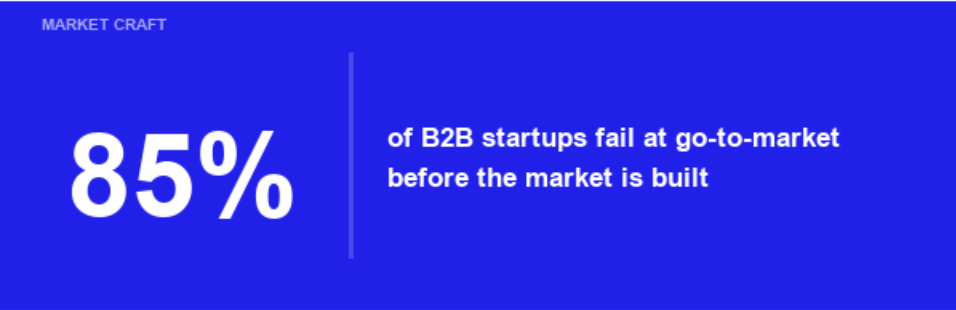
"Without a market there's no need for your product. And that was the problem I had with product-market fit. It put the product first and put the market second. You need to invert that. You need to build the market first. That's why I talk about market product fit, not product market fit. And that's one of the major reasons why I think 85% of B2B startups fail."
— Bruce Cleveland, Founder, Traction Gap Partners (The State of MedTech, ep.278)
In medtech, this distinction is critical.
You're typically constrained by the FDA process. You can't pivot your product dramatically once you're in the pre-clinical or clinical phase.
But you can engineer the market around the product you're building.
You can define the problem in a way that positions your solution as inevitable. You can build conviction that this category is real before you ship.
The pre-FDA clearance window is your market engineering window. Talk to KOLs not as a sales tactic but as thought partners.
Understand how they think about the problem. Publish research or commentary on the state of the problem. Build a narrative around why current solutions fall short. Name the category.
By the time you hit FDA clearance, the market knows who you are and is waiting for you.
The 12–18 Month Category Building Window
Most medtech founders see FDA clearance as the starting gun for commercialization.
It should be the finish line of category engineering.
"You need to build the category before you start doing demand gen. You need to build thought leadership. Invest in that for 12 to 18 months. Keep the burn down extraordinarily low."
— Bruce Cleveland, Founder, Traction Gap Partners (The State of MedTech, ep.278)

Twelve to eighteen months. Before you hire a single salesperson optimized to close deals.
If you're pre-commercial, you're in the window right now. Your job for the next 12–18 months is category definition and thought leadership.
Write about the problem. Publish clinical commentary. Build relationships with the KOLs who will shape adoption. Develop your messaging matrix.
Build conviction inside your buyer ecosystem that this category is real and inevitable.
How do you keep burning low while doing this? You don't hire a traditional GTM team. One person: founder, VP of Growth, or a marketing hire that works on content, relationships, and narrative.
You use existing channels. You publish in industry journals. You speak at conferences. You do podcasts. You build credibility.
The result: when you hit the market, you're not starting from zero awareness. You're starting from a foundation of belief.
What Market Engineering Does to Your Exit Value
This is where the math becomes undeniable.
"76% of the profits of the category accrue to the category leader. So that's why you want to do this."
— Bruce Cleveland, Founder, Traction Gap Partners (The State of MedTech, ep.278)
Category leaders don't exit at modest valuations. They exit at massive ones, because they own the category.
They've shaped how the market thinks about the problem. They've defined the playing field. Competitors are always playing defense.
Axonics didn't invent sacral neuromodulation. They engineered a market around a new positioning of the problem. By the time they exited Boston Scientific, they were the category leader. That's a $3.7 billion exit.
MAKO Surgical built a category around robotic-assisted orthopedic surgery when the market was skeptical. They engineered belief. They became inevitable. Stryker paid $1.65 billion to own it.
This is the advantage of starting with market engineering instead of sales.
You're not competing on features or price. You're competing on category definition. You're the voice that shapes how buyers think about the problem.
When you exit, that category leadership transfers to valuation multiples.
The profits flow to the company that defined the space, not the company that executed the best sales tactics within a space someone else defined.
76% of category profits to the category leader. That's not coincidence. That's leverage.
For a deeper look at how this plays out across real exits, see how medtech founders build toward billion-dollar acquisitions.
Applying This to Your Medtech Company
If you're pre-commercial (pre-FDA or limited market release):
You have the market engineering window. Use it. Spend the next 12–18 months building the five pillars before you hire a traditional sales team.
Get clear on your category definition. What problem are you solving? Not "we're a surgical robot."
What is the problem in the operating room that your technology makes solvable? Reducing surgeon fatigue? Improving precision in challenging anatomies? Standardizing best practices across centers?
Name the category. Give it language that sticks. This becomes your thought leadership platform.
Identify the five to eight KOLs that shape how the ecosystem thinks. Build relationships with them not as prospects, but as thought partners.
What's their view of the problem? What would ideal look like? Incorporate their input into your messaging matrix.
Publish. Write about the problem. Publish in journals, on LinkedIn, in podcasts. Build authority.
By the time you get clearance, the market is primed. Your sales team closes orders because demand is pull-driven, not push-driven.
If you've already launched but adoption is flat:
You're experiencing the classic go-to-market stall. You hired a sales team, you're working hard, but nothing is accelerating.
This is a market engineering problem, not an execution problem. Your sales team isn't the issue.
Fix the narrative first. Do you have a clear, differentiated story for why your category exists and why you're the inevitable leader?
Or are you trying to sell a product in a market that doesn't fully believe in the problem or the category?
If the narrative is weak, no sales team will save you. Invest in thought leadership. Get clear on your category positioning. Build KOL relationships that reinforce it.
Pull your sales team back slightly. Invest in content and narrative. Your closer will have a much easier time once the market has been engineered.
If you're raising Series A or B:
Investors ask one question above all others: is the market real?
If you can point to a clear category narrative, thought leadership positions, KOL alignment, and clinical opinion that supports your positioning, investors believe the market is real. They'll fund the scale.
If you're coming in with strong revenue but weak narrative, investors worry. They see a short-term revenue curve with long-term category risk. They'll demand lower valuation multiples.
Market engineering de-risks the raise. It shows investors you understand the market, not just the product.
For a deeper look at how the framework works in practice, see the five pillars of market engineering applied to medtech. For what happens when commercialization goes wrong post-clearance, see medtech commercialization strategy.
Frequently Asked Questions
What is a medtech go-to-market strategy?
Go-to-market strategy is your plan for launching a product and building a repeatable business around it. In medtech, the traditional GTM focuses on hiring a sales team and executing territorial coverage.
Market engineering inverts this: the market, meaning category definition, narrative, and thought leadership, must be built first.
The sales team becomes the execution mechanism of a market that's already been engineered, not the thing that creates the market.
How is market engineering different from a standard GTM plan?
Standard GTM assumes the market exists and optimizes product and sales execution within it. Market engineering assumes the market must be created first.
It focuses on category definition, thought leadership, messaging, and narrative before deploying sales resources.
Market engineering is the strategy layer. GTM execution is the tactic layer. You need both, in the right sequence.
Why do 85% of B2B medtech startups fail at go-to-market?
Most fail because they lack market conviction. They build products in a market that doesn't believe the problem is worth solving. They hire sales teams to push demand into a market that doesn't pull.
Market engineering addresses this by building conviction first. When 85% of startups fail, the post-mortem diagnosis is "no market need."
That's a market engineering failure, not a sales execution failure.
What are the five pillars of market engineering?
Category design (naming and defining the problem space), thought leadership (becoming the voice that shapes thinking), messaging (translating strategy into language that sticks), narrative (telling the story of why the category matters), and go-to-market (demand generation and sales execution once the market is engineered).
They must happen in order. You cannot skip any of them.
How long does category building take before go-to-market?
Bruce Cleveland recommends 12–18 months of category building before activating full demand generation. Shortcutting this phase is the single most common reason medtech companies fail post-FDA clearance.
The 12–18 months is not a waiting period. It's an active investment in thought leadership, KOL relationships, messaging, and narrative.
Listen to Bruce Cleveland's Full Episode
Bruce Cleveland's full conversation with me on market engineering, the Traction Gap, and what separates category leaders from category participants is on The State of MedTech.
The episode covers the framework in full, including how to measure category adoption and what thought leadership looks like in practice for a medtech company. Subscribe wherever you listen to podcasts.
If you're building a medtech company and want to understand how market engineering applies to your stage, talk to MarketCraft.
About Bruce Cleveland
Bruce Cleveland is the founder of Traction Gap Partners and author of Traversing the Traction Gap.
He spent more than two decades as a venture investor and operating executive at companies including Oracle and Siebel Systems.
He coined the term market engineering and advises early-stage companies on category design and commercial strategy.
About the Author
Omar Khateeb is the founder of MarketCraft and host of The State of MedTech, the number one podcast in the medtech industry.
He works with medtech founders and commercial leaders on market engineering, commercialization strategy, and revenue growth.
Visit marketcraft.ai or subscribe to The State of MedTech for weekly conversations with the people building the future of medical devices.