Axonics: 20 Winning Quarters to a $3.7B Exit
Axonics: 20 Winning Quarters to a $3.7B Exit
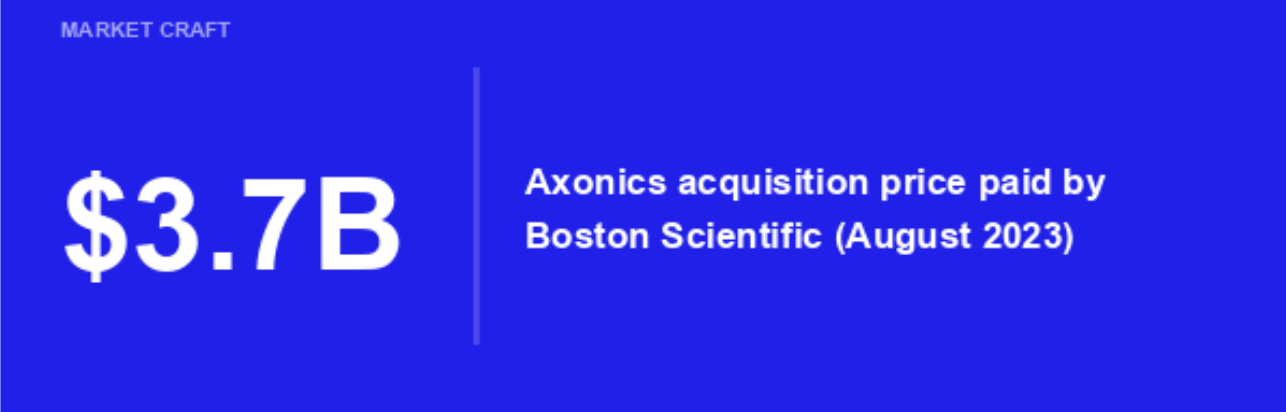
Boston Scientific acquired Axonics, Inc. for approximately $3.7 billion in August 2023.
That's the headline. What the press releases won't give you is what built it.
Ray Cohen, founder and CEO of Axonics, sat down with Omar Khateeb on The State of MedTech podcast to walk through the full arc: founding, commercial discipline, and the exit.
Cohen ran 20 consecutive commercial quarters beating analyst expectations, built Axonics into the primary competitor to Medtronic's InterStim, and chose Boston Scientific as the buyer on cultural fit as much as on price.
Watch the full episode on YouTube
As I said on the episode: "Axonics exited to Boston Scientific for $3.7 billion... they had this meteoric rise in their space."
This post gives you the strategic rationale, the founder's account of why Boston Scientific was the right buyer, and the commercial execution that made Axonics worth acquiring at that number. By the end, you'll understand what actually happened and what medtech builders can take from it.
Key Takeaways
- Boston Scientific acquired Axonics for approximately $3.7 billion, closing the deal in August 2023
- Axonics hit 20 consecutive commercial quarters of beating analyst expectations before the acquisition
- Ray Cohen, founder and CEO, attributes the outcome to transparency, commercial discipline, and knowing when the timing was right
- Boston Scientific was selected not just on price but on cultural fit; Ray describes Mike Mahoney as "authentic as the day is long"
- Most Axonics employees continued with Boston Scientific post-acquisition, an outcome Ray deliberately engineered
- The 11-year journey from founding to exit reflects what disciplined medtech commercialization looks like at scale
Who Bought Out Axonics?
Boston Scientific acquired Axonics, Inc. in a deal that closed in August 2023. Boston Scientific brought an established urology and pelvic health portfolio into the deal. Adding Axonics meant adding the primary challenger to Medtronic's InterStim, the incumbent sacral neuromodulation device, directly into that portfolio.
The strategic rationale was clear from both sides. Axonics had been gaining market share on Medtronic steadily since its 2019 US commercial launch. A rechargeable, MRI-compatible SNM device with a smaller implant profile had given clinicians and patients a credible alternative to an incumbent that had held the market largely unchallenged. Boston Scientific's acquisition folded that competitive position into its existing urology infrastructure.
But the commercial logic is only part of how Cohen described the deal.
Why Boston Scientific Made Sense Strategically
Before agreeing to terms, Cohen had studied Boston Scientific CEO Mike Mahoney's leadership style and how the company operated. What he found aligned with what Axonics had built internally, and that mattered as much to him as the financial offer.
Cohen described what he saw in Mahoney and the company culture directly.
"Mike Mahoney, the chairman and CEO, is one of the greatest guys you'll ever meet. He's authentic as the day is long. He's got the culture of the company, the way they go about doing business, it fit. It matches with Axonics and they're really good people."
— Ray Cohen, Founder and CEO, Axonics (The State of MedTech, ep.245)
That kind of match isn't a nice-to-have for a founder who's spent 11 years building a company. When Cohen cared about what happened to his people and his product after close, buyer culture became a genuine selection criterion.
What Happened to Axonics Employees?
According to Cohen, the majority of Axonics employees continued in their roles at Boston Scientific following the acquisition close. This wasn't a fortunate side effect of the deal. Cohen has described it as something he specifically evaluated when assessing potential buyers.
Cultural fit was, in part, his way of protecting the people who built Axonics alongside him.
How Much Did Boston Scientific Buy Axonics For?
Boston Scientific paid approximately $71 per share in an all-cash tender offer for all outstanding Axonics shares, totalling approximately $3.7 billion. According to Boston Scientific's acquisition announcement, the deal was announced on January 5, 2023 and closed in August 2023 following regulatory clearance and shareholder tender. Full deal terms are also documented in the SEC tender offer filing (Form SC TO-T).
For context, 14 analysts were covering Axonics at the time of the announcement. That level of institutional attention doesn't accumulate from a single strong quarter. It's the result of years of consistent execution building trust with Wall Street one earnings call at a time.
Cohen was direct about what that pressure actually felt like from the inside.
"We had 14 analysts covering Axonics... if you don't beat the analyst consensus, you're dog meat. Your stock's going down."
— Ray Cohen, Founder and CEO, Axonics (The State of MedTech, ep.245)
The $3.7B figure is what consistent delivery looks like over a decade. This was one of the larger medtech acquisitions of 2023 and a direct product of the commercial record Axonics had built quarter by quarter.
What Happened to Axonics, Inc.?
Axonics no longer exists as an independent public company. Its products, people, and commercial infrastructure now operate within Boston Scientific's urology division. The sacral neuromodulation therapy Axonics pioneered, treating overactive bladder, urinary retention, and fecal incontinence, continues to reach patients through Boston Scientific's commercial organization.
The therapy works by delivering mild electrical pulses to the sacral nerves, giving patients with symptoms uncontrolled by medication an alternative to lifelong drug management. Hundreds of thousands of patients have been treated since Axonics launched commercially.
Cohen put the meaning of that outcome in plain terms at the end of the episode.
"When you have an opportunity to be able to do well for yourself and your family and your colleagues by helping other people have a better quality of life, I don't see how it gets better than that."
— Ray Cohen, Founder and CEO, Axonics (The State of MedTech, ep.245)
That's not a ceremonial line. It follows 11 years of grinding commercial execution, and it reflects what Cohen was actually building toward.
The 11-Year Journey from Founding to Exit
Axonics was founded in 2012 with a specific competitive target: build a better sacral neuromodulation device than Medtronic's InterStim. The differentiators were a rechargeable design, a longer battery life, MRI compatibility, and a smaller implant profile. These addressed real patient and clinician pain points that the incumbent hadn't resolved.
Axonics went public on NASDAQ: AXNX in October 2018 and launched commercially in the US in 2019. The company spent the following years executing against a defined commercial plan, building analyst coverage and institutional trust quarter by quarter.
By the time Boston Scientific announced the acquisition in January 2023, Axonics had established itself as the primary competitor in the SNM market and had the earnings history to prove it.

What Was the Revenue of Axonics?
Before the acquisition closed, Axonics was generating over $200 million in annual revenue. According to Cohen, the company had delivered 20 consecutive commercial quarters beating analyst expectations. That stat is evidence of commercial discipline, not just a favorable market tailwind.
Cohen's framing of it was unambiguous.
"20 commercial quarters in a row. We beat our numbers every quarter. There's no other option. There is no other option."
— Ray Cohen, Founder and CEO, Axonics (The State of MedTech, ep.245)
The repetition is the point. Cohen ran Axonics on a simple standard: beat guidance every quarter, no exceptions.
For a medtech company competing directly against Medtronic in a growing SNM market, that kind of consistency over five years is unusual. It reflects a specific leadership philosophy, not just favorable conditions.

What Drove Axonics' Commercial Performance?
Cohen credits transparency as a core commercial discipline. As a public company CEO, he built his investor relations approach around directness: clear guidance, plain-language answers, and no hedged corporate language.
"I only have one way of being. You ask me a question, I'm going to tell you what I think, and I'm not going to put it in corporate speak."
— Ray Cohen, Founder and CEO, Axonics (The State of MedTech, ep.245)
That approach connects directly to deal value. Fourteen analysts choosing to cover a company reflects institutional trust. And institutional trust, built quarter by quarter through transparent guidance and consistent performance, is a meaningful part of what drove Axonics' valuation into the acquisition. If you're building a medtech company and want to understand how market engineering shapes exit value, see how MarketCraft works with medtech founders.
Frequently Asked Questions
When did Boston Scientific acquire Axonics?
Boston Scientific announced the acquisition of Axonics on January 5, 2023. The deal closed in August 2023 following regulatory clearance and shareholder tender. The final purchase price was approximately $71 per share, representing a total deal value of roughly $3.7 billion.
Why did Boston Scientific buy Axonics?
Boston Scientific acquired Axonics to expand its presence in the sacral neuromodulation market, which treats overactive bladder and bowel dysfunction. Axonics held a strong commercial position as the primary competitor to Medtronic's InterStim device, and its rechargeable, MRI-compatible system had been gaining market share steadily since its 2019 US commercial launch.
What did Axonics do?
Axonics developed and sold sacral neuromodulation devices: implantable neurostimulators that deliver mild electrical pulses to the sacral nerves to treat overactive bladder, urinary retention, and fecal incontinence. The therapy serves patients whose symptoms aren't adequately controlled by medication alone.
Who founded Axonics?
Axonics was co-founded by Ray Cohen, who served as CEO from the company's founding in 2012 through the Boston Scientific acquisition in 2023. Cohen spent over four decades in medical devices before founding Axonics, including senior commercial roles at several medtech companies.
Was Axonics publicly traded?
Yes. Axonics went public on the NASDAQ stock exchange in October 2018 under the ticker symbol AXNX. The company remained publicly traded until the Boston Scientific acquisition closed in August 2023.
What happened to Axonics stock after the acquisition?
When Boston Scientific's all-cash tender offer at $71 per share closed, Axonics common shares were delisted from NASDAQ. Shareholders who tendered received $71 per share in cash. There is no longer any publicly traded Axonics stock.
Did Axonics employees keep their jobs after the acquisition?
According to Ray Cohen, the majority of Axonics employees continued in their roles at Boston Scientific following the acquisition close. Cohen has described this as an outcome he specifically evaluated when selecting a buyer. Cultural fit with the acquirer was a deliberate criterion, not a post-deal afterthought.
How does Axonics' SNM device compare to Medtronic's InterStim?
Axonics competed directly against Medtronic's InterStim by offering a rechargeable device with a longer battery life and a smaller implant profile. Both systems treat the same conditions, but Axonics positioned its device as a more patient-friendly alternative, particularly for younger and more active patients who benefit from the rechargeable design and extended longevity.
Listen to Ray Cohen's Full Exit Story
Ray Cohen's full account of building and exiting Axonics is on The State of MedTech. The episode covers his early career in medical sales, the founding of Axonics, the clinical and commercial journey, and the acquisition in his own words. Subscribe wherever you listen to podcasts.
If you're building a medtech company and want to understand how market engineering drives exit value, talk to MarketCraft.
About Ray Cohen
Ray Cohen co-founded Axonics in 2012 and served as CEO through the company's $3.7 billion acquisition by Boston Scientific in 2023. He spent over 40 years in medical devices before founding Axonics, holding senior commercial roles across multiple medtech companies. Cohen is now retired from operating roles and serves on medtech boards and as a venture adviser.
About the Author
Omar Khateeb is the founder of MarketCraft and host of The State of MedTech, the number one podcast in the medtech industry. He works with medtech founders and commercial leaders on market engineering, commercialization strategy, and revenue growth. Visit marketcraft.ai or subscribe to The State of MedTech for weekly conversations with the people building the future of medical devices.